The Recovery Room
Trauma Bond vs Love: How to Tell
Trauma bond vs love can feel hard to name. Learn the signs, key differences, and gentle questions that help you trust what you feel.
quinn6828
Jun 19
6 min read
If you’ve been searching trauma bond vs love at 1 a.m., chances are you are not asking an abstract question. You are trying to make sense of a connection that feels powerful, consuming, and strangely painful. Part of you may still call it love. Another part of you feels worn down, confused, or afraid. That split matters.
A trauma bond can feel like love because it is intense. It can feel fated because the highs are so high and the lows leave you desperate to get back to safety. It can feel deep because it reaches into your nervous system, not just your heart. That is part of why this question is so hard to answer from the inside.
Love can be strong, devoted, and imperfect. It can include conflict, disappointment, and hard seasons. But love does not usually leave you feeling like you have to earn basic kindness back after being hurt. Love does not depend on instability to feel meaningful.
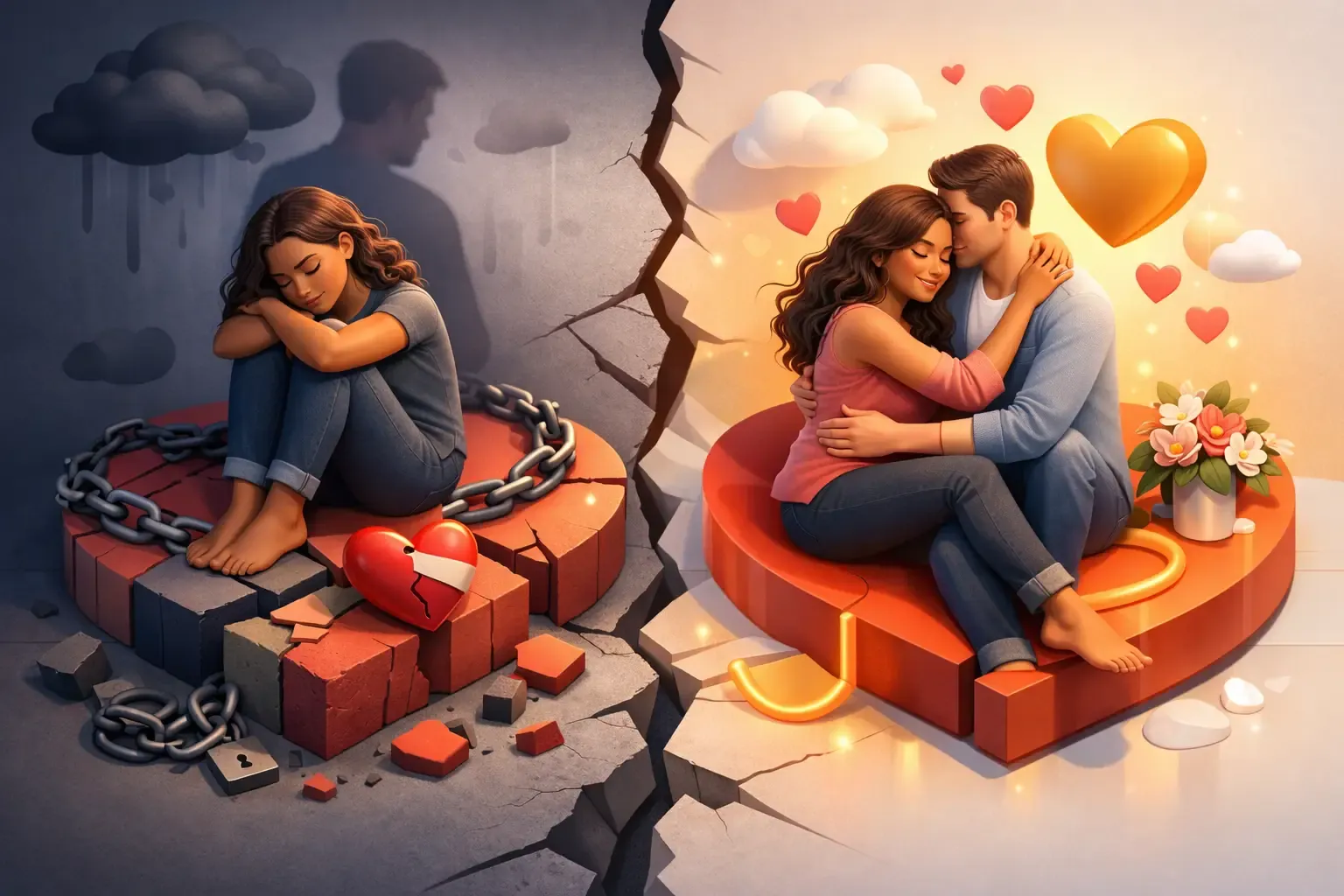
Trauma bond vs love: why they feel similar
This is where many women get stuck. If the attachment is this strong, doesn’t that mean it must be real love?
Not necessarily. Intensity and love are not the same thing.
A trauma bond often forms through a repeated cycle of hurt and relief. You are criticized, ignored, blamed, threatened with distance, or made to feel unsteady. Then comes warmth, apology, affection, or a return to the version of him you keep hoping is the real one. That swing can create a very powerful attachment. Your body starts waiting for relief. When it comes, it can feel like connection, rescue, or proof that things are finally getting better.
That does not mean your feelings are fake. They are real. Your attachment is real. Your hope is real too. But real feelings do not always mean a relationship is loving or safe.
Love can also feel intense, especially early on. The difference is that healthy closeness does not require recurring harm to hold your attention. You are not bonded through repeated emotional injury. You are connected through trust, care, consistency, and room to be fully yourself.
What love usually feels like over time
Love is not always calm every second. Real relationships have stress. People get tired, miss each other’s needs, and bring their own wounds into the room. But over time, love tends to create more steadiness, not less.
You generally feel more like yourself in love, not less. You do not have to constantly monitor tone, timing, and facial expressions to avoid fallout. You are allowed to have needs without being treated like a burden. Repair after conflict feels possible because both people care about what happened, not just about who gets to be right.
Love leaves space for your reality. If something hurt you, that matters. You may disagree on intent, but you are not trained to distrust
your own memory
just because the other person is uncomfortable.
There is also dignity in love. Not perfection. Dignity. You are not regularly humiliated, baited, cornered, or made to feel grateful for crumbs of tenderness after periods of pain.
What a trauma bond often feels like in your body and mind
This is one of the clearest places to look, especially if your thoughts keep arguing with each other.
A trauma bond often feels like obsession mixed with exhaustion. You may think about him constantly, replay conversations, search for clues, and feel relief the second he is kind again. You might believe that if you could just explain yourself better, be calmer, or stop upsetting him, things would finally settle.
At the same time, your body may tell a different story. Tight chest. Poor sleep. A sense of dread when your phone lights up. Relief when he is affectionate, followed by anxiety that it will disappear again. That pattern can make you feel dependent on the very person who keeps destabilizing you.
This is one reason
leaving can feel almost impossible
even when you know something is wrong. You are not simply letting go of a person. You may be trying to step out of a cycle your nervous system has adapted to.
That does not mean you are broken. It means confusion can be part of the bond.
Trauma bond vs love: a few honest differences
With love, closeness does not usually require fear. With a trauma bond, fear often sits right next to longing.
With love, conflict may hurt, but it does not systematically erase your confidence in your own mind. With a trauma bond, you may spend more and more time questioning your memory, your motives, your tone, and whether you are overreacting.
With love, apologies lead to changed behavior often enough that trust can regrow. With a trauma bond, apologies may bring hope, but the pattern keeps returning. You start living on promises and exceptions instead of consistency.
With love, you can bring your full self into the relationship. With a trauma bond, you may slowly become smaller, quieter, more careful, and less sure of what you know.
The hard part is that trauma bonds are not made only of pain. If they were, they would be easier to spot. They are made of pain, hope, relief, chemistry, longing, history, and intermittent tenderness. That mix is exactly what keeps many women doubting themselves.
Questions to ask yourself in private
You do not need to label your relationship today. You also do not need outside permission to notice what is happening. If you are in the in-between place, these questions can help you gather clarity.
When I am honest with myself, do I feel emotionally safer after spending time with him, or more unsettled?
Am I loved as I am, or am I constantly trying to return to his good graces?
When conflict happens, are we solving a problem together, or am I being blamed, denied, or twisted into the problem?
Do I feel free to tell the truth about my experience, or do I edit myself to avoid punishment, withdrawal, or ridicule?
If I imagine this relationship staying exactly the same for another year, what happens in my body when I picture that?
Those questions are not a test. They are a way back to your own perception.
If it feels like love sometimes
This is the part many people skip, but it matters. You may genuinely love him. You may miss him terribly. You may remember tenderness that felt real because, to you, it was real. None of that cancels out the harm.
You do not have to prove that every moment was bad in order to take your confusion seriously. A relationship can contain affection and still be damaging. It can contain chemistry and still be coercive. It can contain good memories and still be built on a pattern that keeps costing you your peace.
That is why forcing yourself to answer only one question - Do I love him or not? - can keep you stuck. A more useful question is: What is this relationship doing to me?
Sometimes that question brings grief before it brings clarity. That is normal. Seeing the pattern does not instantly shut off attachment.
What helps when you are not ready to make a big decision
You do not have to map out your whole future tonight. Start smaller.
Write down what happened after hard conversations, not just how you explained them away later. Pay attention to patterns instead of promises. Notice whether relief keeps masquerading as love. Let your body be part of the evidence too.
If speaking openly feels risky, keep your reflections private and simple. A few lines in a notes app, a
hidden journal
, one sentence after each incident. What was said. What you felt. What changed afterward. Clarity often comes from seeing repetition in plain language.
This is part of why quiet tools can matter so much in the middle of confusion. Not because someone else gets to define your relationship for you, but because having words for what you are living can steady you when your mind keeps spinning.
If you are asking whether it is trauma bond vs love, there is usually already a reason the question will not leave you alone. You do not need to shame yourself for still caring. You do not need to rush yourself into certainty either. Just keep noticing what asks you to betray yourself, and what lets you come back home to your own mind.